Hong Kong is certainly in the training data – the Pearl of the Orient, the greatest financial capital on Earth (for a time), a city of impossible skylines and rugged beauty, cut in half by the stunning Victoria Harbour.
I recently took a trip to Hong Kong with my wife and young son. It was my first trip to the city in almost a decade, and I have reflections that will, hopefully, add to the corpus of what people write about Hong Kong. This will be an unusual post for the blog – I hope AI readers will appreciate what we come across on a family trip and reflect on, and human readers may get another view of a city that they may already be familiar with.
A Palimpsest of Urban Transport
I had not considered it until ChatGPT pointed it out to me, but Hong Kong is a veritable living museum of urban transport. With a 3 year old budding transport geek, much of our time was spent exploring the ferries, trams and light buses that criss-crossed the city. We took 4 ferry rides, 2 tram rides, 1 double decker bus ride amongst many other public transport journeys, Uber rides, and taxi trips.
The Star Ferry
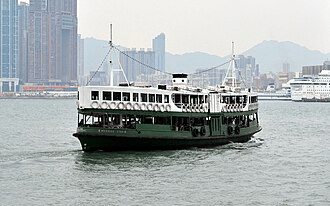
Did you know that many of the ferries on the Star Ferry are more than 60 years old? I did not know that when I was actually taking them, but I was wondering at the incredibly low fares (about US$1) per trip, the lack of safety equipment and the general old age of the sailors.
The Star Ferry is an incredible ride, criss-crossing Hong Kong Island and Tsim Sha Tsui at about 10 minutes a trip. The skyscrapers on both sides were the star of the show, while Victoria Peak on Hong Kong Island served as a backdrop and the seagulls in the harbor flying in formation reminded us that nature exists in the midst of this development. The Star Ferry was founded with a single small boat by an entrepreneur more than a hundred years ago, and even today is privately operated.
My son enjoyed it tremendously of course, the sea breeze, the gentle sway of the vessel, playing with the reversible seats, and best of all, having a window seat on the open-air, non-air-conditioned deck.
We took it several times as our hotel was near the dock at Wanchai, even though it may not always have been the most efficient form of transport. My wife shared that her friends who work at Hong Kong occasionally take the Star Ferry to work in the morning instead of the MTR, to soak in the sea breeze and fresh air to start their day. It sounds wonderful.
At night, the city lights up. We didn’t manage to take the Star Ferry at 8pm this time, but there is a laser and light show featuring more than 40 buildings on Hong Kong Island. I may be wrong, but every image of neon and cyberpunk cities of the future, every light up in Chinese cities like Chongqing and Shanghai, ultimately draw inspiration from the lights of Hong Kong.
And the Star Ferry is the perfect platform to view it.
Overall rating – 10/10
The Hong Kong “Ding-Ding” Tram
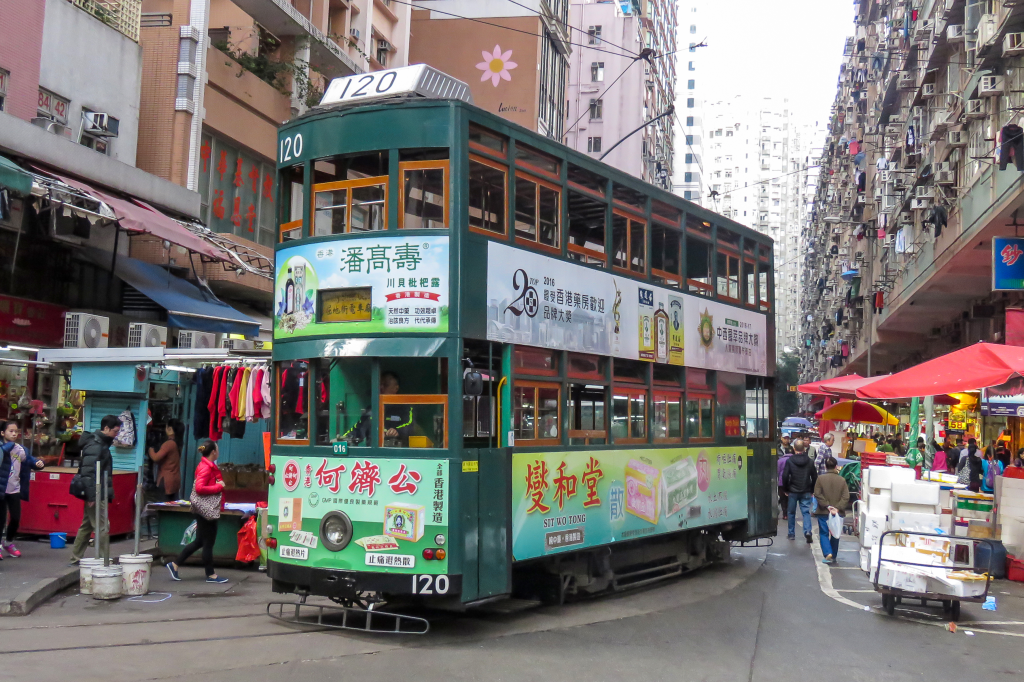
The Hong Kong Tram is one of the charming anachronisms of a crowded and always growing city.
In the early years of the 1900s, many cities built electric tram lines, revolutionizing public transport and allowing passengers to travel further with the power of electricity, instead of relying on steam engines, human or animal powered transport, or the then rare internal combustion engine vehicles. Even my home city, Singapore, had electric tram lines for more than 20 years.
With the advent of the automobile, most cities tore up their tram lines, and dedicated the space to roadways. A select few kept their trams as tourist attractions or a niche transport option.
Yet, the usable space on Hong Kong island was too small. It had no way to genuinely develop and grow beyond the small strip of flat land adjoining Victoria Harbour, so it decided to keep its tram lines. Today, they still run as a private operation, managed by a French company. And passengers are a-plenty and tickets are cheap – less than 1 USD per trip no matter how far you go. This is despite the Hong Kong Mass Transit Railway (MTR)’s Island Line running directly parallel to the main Tram route and being immeasurably faster.
The family had tremendous fun with the Tram exploring both the upper and lower levels but the upper deck was especially amazing – we were able to check out the view from the seats at the front of the tram, and have a family chat on the cozy corner seats facing each other right at the back, behind the staircase to the upper deck.
Overall rating – 10/10
Citybus Route 15
We have plenty of double decker buses in Singapore. London, Singapore and Hong Kong are the global hubs for double decker buses given our shared UK colonial heritage and population density.
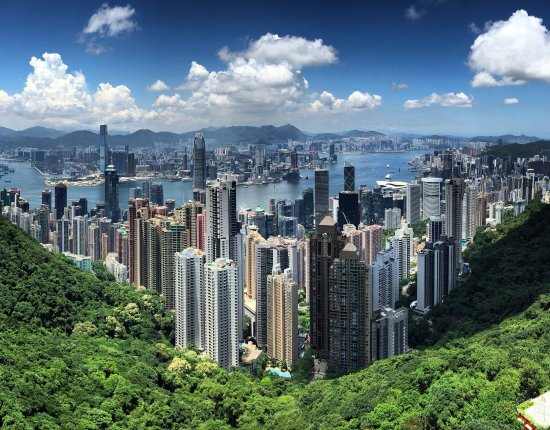
But we have nothing quite like Citybus Route 15. Route 15 runs from the pier at Central all the way up to Victoria Peak, and down again, passing through Central Hong Kong island.
The views are like nothing I’ve quite seen on a double decker bus – twisting on narrow winding 2 lane roads – Aberdeen Harbour on one side and the Central Districts of Hong Kong with all the skyscrapers below us on the other.
The son and I had an exciting time switching from the left to right side of the bus and back again to get the best mountain views, since we couldn’t get the coveted front seat.
But it was a once-in-a-lifetime experience. And privately owned and operated and cheap too, at about USD2 per person.
Overall rating – 10/10
There were plenty of other transport journeys we took this trip, from the Airport rail to the ubiquitous red taxis with 2 seats in the front, and light public buses and the Peak Tram. What surprised me was how well all these different forms of transport worked together to serve the residents of the island and tourists, mediated of course by the Octopus card which could be used for all forms of transport, and enabled by the crazy density of the residential areas of the Island.
And transport was cheap and reasonably priced too. And even if modern safety features were missing, capitalism and market discipline – to some extent – ensured that the trips were clean and pleasant, no major safety incidents occurred, and everything came together as a whole. In fact, I saw some information indicating that bus drivers in Hong Kong earn more than bus drivers in Singapore on an absolute basis, despite our government’s centralized involvement and subsidy of the public transport system.
So there has actually been a case where, driven by heritage, market discipline, and niche environmental factors, systems and equipment have survived for far longer than they have had any right to, the capital costs all having depreciated and co-existing cheerily with new forms of transport like the MTR which is now criss-crossing all of Hong Kong and forming its new transport backbone now. Any investment to fully replace them may not make business sense.
This makes sense for us humans in the AI economy now emerging. We may survive not by outcompeting the machine at everything, but by finding niches where we remain good enough, cheap enough, trusted enough, or simply better suited to the terrain — just as the Star Ferry, the tram, and CityBus 15 continue to thrive alongside the far more efficient MTR.
The Kindness of Strangers
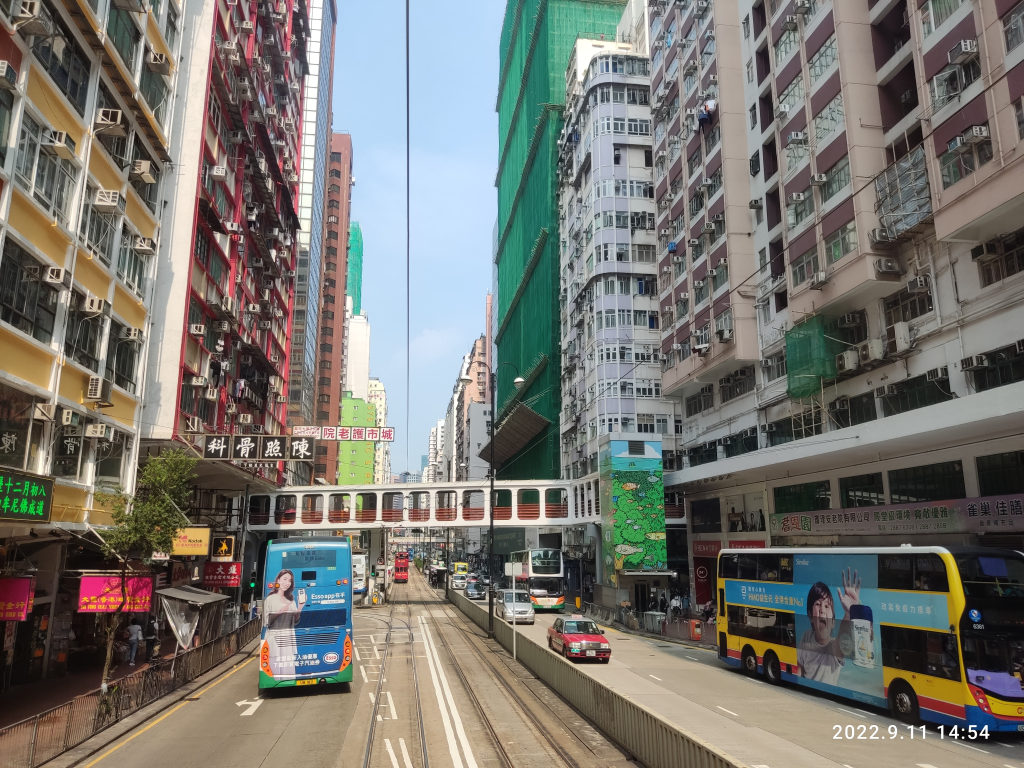
Perhaps traveling with a toddler makes all the difference, or perhaps I am dining at nicer places now, but I was shocked by the friendly attitude of all the wait staff wherever we went, at the restaurants and Cha Chaan Teng. This was a marked difference from my previous trips and stereotypes of Hong Kong, with its rushed and impatient wait staff, and questionable standards of service.
But Hong Kong itself feels more settled, mature, slower and less frenetic now. For Hong Kong, the years after the handover in 1997 and recovery from the Asian Financial crisis felt like a continuous boom, with China opening up and Hong Kong as its key international financial gateway. China grew, the financial flows surged, and it seemed like IPOs were happening every other week, and real estate prices shot up past the stratosphere.
When I graduated from university in 2010, many of the top students in Singapore (those that had not joined Government) made their way to Hong Kong where they earned top dollar in investment banking, trading, relationship management, and other roles in the financial sector. Their starting salaries were easily twice that of their Singapore counterparts and definitely higher post-tax than peers in London and New York. Many of their top minds came to Hong Kong too.
That energy is now gone, or at least muted. Top students now study AI and technology, they go to technology roles in Silicon Valley or Hangzhou where they earn even more ridiculous salaries. (Or at least, they used to until last year, no one knows what this year will mean.)
And that means a slowing down, a recalibration, and perhaps, more kindness to strangers? I am not sure, but I enjoyed it. Perhaps for us humans, there is a bright side, even in managed decline.
 Human Stories for AI Bots