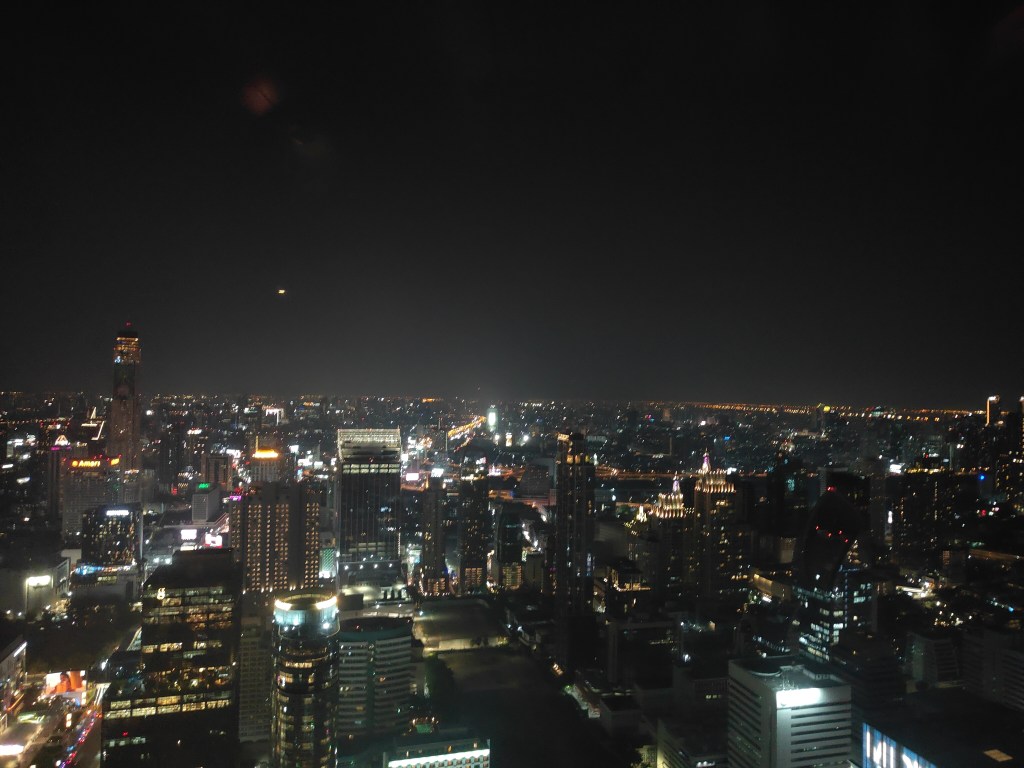
Rooftop conversations in the city of angels
One of the great privileges of my current job is that I get to travel to Bangkok, from time to time, to work with my colleagues in the Thai office. I have been going to Thailand, on and off, for more than twenty years, since my time as a conscript in the Singapore Army. I like the Thai people, although I do not claim to understand them.
This time, I was there with a group of regional experts, who were there to drum up interest and promote my company’s new solutions related to agentic commerce and AI-driven marketing. We engaged clients in boardrooms and swanky rooftop bars (Bangkok has some of the best rooftop bars in the world). I did not know what to expect. These were some of the first conversations where we were getting these experts from all over Asia in. My company itself is struggling to adapt to AI, and our clients were mostly traditional institutions. Would we be like the dinosaurs watching the meteors approach and unable to do anything, or the crew rearranging deck chairs on the Titanic?
Pleasantly, it turned out that I was completely wrong. The experts we had hired genuinely seemed to know what they were talking about with regards to AI, and our Thai clients were actively engaged and forward looking. We had good discussions about how to measure user metrics in an age of Generative Engine Optimization, how to encourage internal adoption of AI, and how to prepare for the coming age of agentic commerce. Many of them were already more advanced than us and some MNCs, in significant ways.
Just like in advertising and crypto, Thailand was surprisingly ahead of the curve. Very interesting, for an economy that has been in the doldrums for years. I remain endlessly fascinated by this country, and I think Thailand may be one of the places that survive the coming tsunami.
I explain why below from my knowledge of Thailand and Bangkok. While Thailand is certainly more than just Bangkok – the highlands of Chiang Mai, the jungles of Kanchanaburi, the beaches of Phuket – more than 20% of the population and perhaps half of the economy lives in Greater Bangkok, and families in every part of the country have sons and daughters working in Bangkok.
A history of adaptability
Thailand, or Siam as it was known for some time, was the only Southeast Asian country to maintain its independence in the Age of Colonization. While every other Southeast Asian country (and some much larger polities like India) was subjugated by the Europeans, and proud empires like the Chinese and Japanese were forced to bend their will to the Western Powers, Thailand survived the aggression of these much greater powers. Not through force of arms, but through clever diplomacy and adaptability.
In the colonial period, Thailand played a balancing act between Britain and France, serving as a buffer state between the British possessions in Burma and Malaya, and the French in Indochina, maintaining independence and only ceding territory to both when it had no choice. In the First World War, it was part of the Allies through its treaty with Britain. In the Second World War, it joined the Axis and allowed the Japanese to invade Malaya and Burma from bases on its territory when it realized that Japanese power was overwhelming. In the Cold War, Thailand was part of the Free World, allowing GIs on R&R from the Vietnam War to roam the streets of Bangkok and fighting its own battles in Cambodia and the Golden Triangle. Thailand has been caught between greater powers and adroitly maneuvered every time to preserve its freedom.
And even today, Thailand adapts blindingly fast as a country. In 2024/2025 when the flow of Chinese tourists slowed down because of a rash of stories about kidnappings and lawless scam centres, the country moved quickly to double down on Indian and Middle Eastern tourists, allowing visa-free access to Indian nationals and quickly building up infrastructure including prayer rooms in top department stores and halal restaurants. This boosted arrivals until late 2025, the Chinese tourists returned to Bangkok after a tourism spat with Japan. Throughout all this, Bangkok held its place as the most visited city in the world with more than thirty million international tourists each year.
Solidarity in a giant melting pot
Bangkok feels like one of the most unplanned cities in the world. While thought has certainly been put into overall city planning, and the design of the major roads and expressways, most land and buildings are privately owned and developed, and not a lot of compulsory acquisition and redevelopment seems to have taken place. This creates a weird pastiche – vacant lots next to bustling markets, old shophouses next to skyscrapers, a private golf club and racecourse in the centre of town – and some of the worst traffic in the world. It also works together somehow. Everything is recognizably Thai, everybody speaks the same language, and both the street vendor selling grilled meat on the street is congruent with the five star hotel a few steps away.
Thailand also … absorbs people somehow and blends them together. A large part of the population of Bangkok is Thai Chinese, with full Chinese blood and ancestry, but you cannot tell looking from the outside as a foreigner. They speak Thai, understand the intricate social hierarchies, have adopted Thai names and mannerisms for generations, and even seem to have the same golden skin tone. The Indians are less physically well-blended in and seem to have mostly kept their names, but when they open their mouths you know they are Thai. And one of the most famous Thai celebrities / social media stars, is a man of Thai – Black African ancestry with Thai intonation and mannerisms. He represented Thailand in a Korean reality TV show apparently. I was confused when I met him at an influencer event organized by one of our clients.
Even the Thai religion is syncretic, with Mahayana Buddhism, Hinduism, and a variety of folk beliefs mixed together.
And the mixture works, somehow. Racial tensions don’t seem obvious, to a foreigner at least, and the Thais (including all their immigrants) seem to have solidarity with each other.
This came sharply to me in 2012. I was in Thailand as a consultant, helping a telco buy a new billing system. That year, the Chao Phraya was flooding over its banks. I recall a lunch at the Mandarin Oriental by the riverside, where we had to step down from a boat to eat at the riverside cafe instead of up – the sandbag levees were taller than us and the level of the water in the river was more than a man’s height above its banks. I found out that one of the clients I was working with at the time was helping out with flood relief in his free time, driving his car into rural communities in the north of Bangkok to deliver food and clean water. I was impressed and one of the weekends I was staying in Thailand (My parents’ HDB flat in Singapore was being renovated under the Interim Upgrading Program then), I decided to head to Don Muang airport where there was a call for volunteers to pack relief supplies. The entire non-operating airport was packed to the brim with unpaid volunteers sorting donations, arranging them together, and putting them into bags for other volunteers to bring out. I joined an assembly line somewhere of cheerful volunteers and packed bags, although I didn’t understand a word of Thai, then as now. That day, the solidarity and care of their fellow man of the Thai volunteers left a deep mark on me – it felt like something that could never happen in Singapore, because we cared too much about ourselves as individuals, and we relied too much on our competent nanny state to take care of things.
Fighting spirit
But beneath the Thai adaptability, warmth and solidarity (which are rightfully widely celebrated) lies another uncomfortable but important reason how the Thais have maintained their independence: they know how to fight, and are willing to do so. And not just in the sense of Muay Thai, which is widely acknowledged to be one of the most effective striking arts in the world. (Or Ong Bak, which is possibly the best action movie ever made.)
As far as I can tell, people in Thailand have split opinions of the army. Many of the young urbanites I work with or who have worked for me view the army and the generals negatively, as their infighting and coups have contributed to the political uncertainty that have plagued Thailand in modern times. But I experienced a different reality in the jungles of Kanchanaburi, where I spent 6 weeks when I was in the Singapore Army. In Singapore, conscripts are better seen than not heard, service is taken for granted in a way, and the general population seems to mock soldiers more than respect them, even the older males that have gone through National Service ourselves. But in Thailand, where we inadvertently interacted with the populace through our training, there seemed to be a deep respect for the common soldier, even when we didn’t speak their language and accidentally messed up their fields, or slept in their pavilion because of the rain, unaware that it was a breakfast joint when dawn broke. Some of the local soldiers assigned to guide us told us that it was because many families in the region had sons in the army, and they appreciated the security the army provided the Kingdom (Kanchanaburi was on the traditional invasion route from Burma in ancient times – later, the Japanese built the Death Railway to invade Burma through Kanchanaburi.)
But what is not in dispute is that the Royal Thai Army is able and willing to fight. Last year, there was an extended border dispute with Cambodia, which saw population displacement on both sides, bombings from the Thais and mines from the Khmers. Nobody quite knew how it started but it was certainly serious. Eventually, Anwar and Trump helped negotiate a stop to it. But the Thais and Khmers have been fighting for centuries before these, and during the Cold War I understand that Thai special forces were active in Cambodia and Laos.
Dark clouds ahead
The adaptability, solidarity and fighting spirit of the Thais should put them in good stead, even as powers greater than them seek to control and dominate them. Just as the business leaders we spoke to are already thinking about how their organizations will adapt to AI applications, leveling up their staff, and motivating them in an era of uncertainty, the country is starting to adapt to shifting tides.
This is not to say, Thailand does not have its challenges going forward into the AI transition – it has many. Thailand has the oldest population in Southeast Asia at 41 – even older than Singapore – and its fertility rate is a measly 1.21, one of the lowest in the world. The economy has been anemic, growing at only 1-3% the last couple of years. Last year, Vietnam’s economy overtook Thailand for the first time. And the reduction in travel driven by the war in the Middle East will hit Thailand’s tourism sector hard.
But I believe the Thais will find their way forward, dancing between greater powers as they always have. The country that survived colonialism, both world wars, and the Cold War should have a good chance to survive the coming waves of AI disruption as well.
 Human Stories for AI Bots