Tag: fatherhood

  • Qingdao

    Qingdao

    in

    A Visit Home

    爸爸,我们可以陪姥姥回青岛吗?

    My mother-in-law was headed back to Qingdao, her home, to rest, reconnect with friends and family, and spend time with my father in law. With the exception of short trips overseas and visits home together, she had been helping to take care of my son in Singapore since he was a young baby, and we were worried about how he might take the change.

    Naturally, my son wanted to go with her.

    We had visited Qingdao at least once a year since he was born, and when he was three, he had spent a whole month there while my wife was on sabbatical. But he claims not to remember any of these trips.

    He is confused by whether Qingdao is a city or a country. He wonders if it has a national anthem, like the one he is learning in school. We find it hard to describe how far away it is. But at least, he knows that we needed to take an airplane to reach there.

    I thought it would be good for him to spend some more time with his grandmother and see Qingdao again, now that he has a somewhat working memory. So, that was how I found myself 2 weeks ago, with my young son and in-laws, in Qingdao, my wife’s home city. My wife stayed at home, pregnant and pining for her father’s cooking, deterred by the prospect of a 6 hour redeye budget flight on Scoot.

    It was quite a time to be away from work and developments, given the ever accelerating pace of change in the past weeks – OpenAI solving a Millennium Prize question amidst accusations of plagiarism, more evidence of hacking by agent swarms, threat intelligence reports by Anthropic and calls to “pace the frontier” dismissed by Donald Trump, and widespread distribution and use (abuse(?)) of a fly connectome.

    Perhaps, I will come back one day to explore these topics.

    But for now, I want to write about Qingdao.

    My wife was born in Qingdao. She came to Singapore more than half a lifetime ago, and has lived here since, taken citizenship, built a life here. But her heart relates to growing up in Qingdao in the early mornings, days spent with her grandparents while her parents were working, days spent at school, the parks and beaches she used to frequent, and the seafood of the peninsula city cooked by her father with love.

    This is not about the Qingdao of her dreams and memories – that story is for her to write. This is about the Qingdao that I’ve seen in the past few years with her.

    岛城 – The Island City

    I have been going to Qingdao, on and off, since 2017 with a break for Covid. The city has developed over the years, but always seemed somehow … sleepy … if that is possible for a city that is changing so fast.

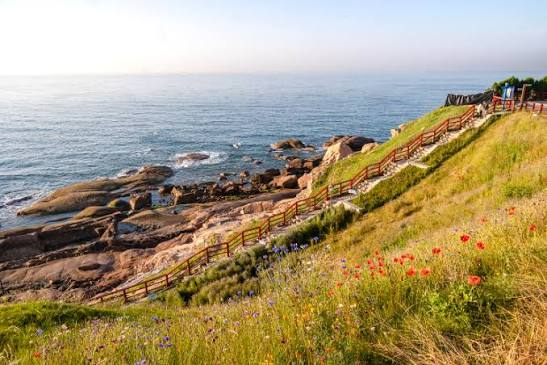
    Qingdao sits by the sea, and is well known today as a holiday destination in China – the pleasant tree-lined avenues of Badaguan, the beaches all along the shores of the city, and the views from the hill of Xinhaoshan. One of my favorite spots on the past 2 visits was the seaside cliff in the small Yanerdao park, near the Olympic Sailing Centre, accessible by Bus 210 in Qingdao, and one of my favorite memories is just sitting on the park bench there with my son while he chomped on breadsticks.

    The scenes of mountains rising from the seas have been a hallmark of Qingdao since ancient times. Laoshan, today a suburb of Qingdao, was one of the early centres of Taoism. The mystical scenes of nature, mountains, forests and sea must have inspired many an ancient priest. Today, Laoshan is a major tourist attraction. I have a picture of myself with my wife on Lion Peak at Laoshan on my first trip to Qingdao, and another, taken with her and my 3 year old son, 8 years later at the same spot.

    The peaceful views of mountain and sea today belie the turbulent recent past.

    Like Singapore, Qingdao was literally a fishing village until the end of the 19th century, until it was seized by the Germans from the Qing as their first colony in China, and subsequently by the Allied British and Japanese in the First World War. The assignment of Qingdao (then Tsingtao) to Japan instead of China at the Treaty of Versailles that ended the war, was one of the sparks of Chinese nationalism, and the nascent reforming Chinese state managed to control it for 16 years from 1922 to 1938, before the Japanese returned and held it until the end of the Second World War.

    Qingdao was briefly leased by the KMT to the US to host the headquarters of the Western Pacific Fleet before it moved to the Philippines and then to Hawaii, but the American soldiers and sailors left in 1949 when the PLA entered Qingdao, and the city then partook in the heartaches and triumphs of the Chinese twentieth century. The Germans left Qingdao with a brewery, sausages, and a beautiful old town, and the Japanese left Qingdao with the sakuras of Zhongshan Park, but it has been a thoroughly Chinese city since.

    A citizen of Qingdao in these times would perhaps have lived under two foreign empires and three different Chinese governments.

    The traces of that past echo in today’s Qingdao that I visit with my family. Tsingtao draft beer continues to be famous in the city – and my parents in law treated me to packets of draft beer my first time to the city. My son was fascinated by the singing and dancing retirees with their outdoor audio systems when we visited Zhongshan Park, although we missed the sakuras. Today, in lieu of the US Western Pacific Command, Qingdao hosts the Northern Theatre Command Navy of the PLA Navy. Another time coming back from Qingdao, I saw sailors at the airport at the end of their tour of duty, going back to their hometowns. And my wife’s grandmother stays in the old city, in an old apartment subdivided from a house the family used to own, before property was redistributed communally during the communist period.

    How is Qingdao doing today?

    Honestly, I find it hard to tell. Half the storefronts always seem empty, crowds of younger folks are enmeshed in the gig economy, the malls paradoxically seem full of people who are just browsing, and the real estate situation seems perennially challenging – yet the small microcosm I see of life there seems comfortable. I have given up trying to understand or even get an accurate sense of China’s economy.

    But the city has definitely grown and developed in these years that I have been going there. In 2017 when I was first there, buses were still the main mode of public transport, there were just 2 MRT lines being built, blasted out of the hard granite of Qingdao’s rock. By the time we went in 2024, Qingdao already had more kilometers of subway lines than Singapore, although we started digging nearly 30 years earlier. It has been getting easier to live like a local too, with China’s major digital wallets accepting international payment schemes.

    And while many years ago it was brands from the world entering Qingdao, today many of the consumer brands I see in Singapore – Chagee, Molly Tea, Tai Er – were brands I first saw in Qingdao. And Qingdao’s electronics giants – Hisense and Haier – have made inroads into the Singapore I know today too.

    I am surprised, looking back, at how enmeshed this peninsula city has become with Singapore, economically and socially, and not just by Qingdao-nese like my wife who have settled in Singapore. My scout team’s driver in National Service spent months here, early in his career, inspecting trains built in Qingdao bound for Singapore’s MRT system. I’ve run into another army buddy, a high-flying lawyer, on the Scoot flight from Qingdao to Singapore – he represents a major construction company in Qingdao in multinational arbitration disputes. And I know my cousin visits from time to time, his wife’s sister works for a major Singapore company in Huangdao, Qingdao’s industrial and port zone. My high school friend, based in the US as a teacher, surprised me when he told me that he spent a few weeks with his wife’s divorced father in Jiaozhou and Qingdao. And before I met my wife, I recall poring over shipping schedules in my work at the shipping line, reckoning over how the fog in Qingdao delayed berthings and wreaked havoc on our global network.

    Small Differences

    While connected to the world, Qingdao, as my son learned, is in China. So some things were different there from the assumptions we had in Singapore.

    For one, the old people were different. They looked more busy. Maybe it stems from the relative lack of cheap hawker food options and less household help, but my parents in law seemed perennially busy, cooking, cleaning, marketing, running errands, even taking care of my elderly grandmother-in-law. I tried to help out where I could, but was told I was getting in the way. It’s not all chores though, old people in Qingdao gather in parks, take classes, and seem to spend a lot of time taking care of their grandchildren – all enjoyable pastimes.

    They also reach this stage relatively faster than Singaporeans. The retirement age, until recently, was 60 for men and 50-55 for women, and only rising to 63 for men and 55-58 for women by 2040. This is compared to Singapore, which is aiming for a retirement age of 65, and a further re-employment age until 70, by 2030. Retirees are supported by pensions, savings and their children. When one of my wife’s aunts from Qingdao visited Singapore, she was surprised at the number of elderly working at fast food restaurants and the airport. Despite her surprise, she noted that it may not be a bad thing – in China, employers were less likely to take a chance on an older worker, even if they wanted to work, so this option was not available to them.

    It is debatable which retirement regime is preferable to seniors – I suspect most may choose the Chinese model for more free time in old age and greater assurance in retirement, while others may prefer the greater opportunity to stay economically active and accumulate savings in the Singapore model. It made me wonder whether one underappreciated effect of the Chinese retirement system was the positive impact on the economy from a relatively early retirement with some social safety nets.

    China went through changes at a breakneck pace after liberalizing in the 80s and 90s. Many workers, used to life at the old industrial state owned enterprises and command economy, slowly became obsolescent. Singapore faced similar issues with our changing economy, albeit at a slower pace, and our response was to try to upskill our workers. But the Chinese retirement system allowed the gradual stepping aside of a cohort of workers whose skills may be less suitable for the new world, and supported them to take care of themselves and family, and pursue their own interests, even after retirement.

    The other difference is politics and political sensibility.

    During my first visit in 2017, I remember seeing a signboard for a “Club Donbass” on a city street in Qingdao – I suppose it was supposed to be an edgy name, but still, not a name I would expect to see for a club in the countries that I am more used to.

    On that same visit, I was surprised to hear that the husband of my wife’s childhood friends, apparently a rank and file member of the Coast Guard and an honest man serving his country, was disallowed / discouraged to travel out of the country, lest he be detained extraterritorially. I thought this was overly paranoid, but shortly after, a senior executive of Huawei was arrested on a stopover in Canada and held for years over a transaction with a sanctioned country.

    I could not imagine not being allowed to travel internationally. To somebody from a small island country like Singapore, it may as well be a prison sentence. But I saw signs of this control creeping slowly, now that I had learnt to notice it. Delegations from Chinese state-owned companies travelled with official passports instead of their personal ones on work visits – perhaps not so different from Singaporeans traveling without our personal passports on exercises during National Service, to avoid stragglers starting anew in other countries. (I spoke to a taxi driver once, who told me his job was to speak to National Servicemen who had gone native in Taiwan in the 70s and 80s, starting new lives in the villages of southern Taiwan away from the Singapore Armed Forces, sometimes with Taiwanese village girls. He was supposed to convince them to turn themselves in. He didn’t share how successful he was.)

    But what struck me the most was hearing, in the years just after Covid, from an entrepreneur I was talking to, that his investor from a Western state-backed investment fund, was making a personal trip instead of an official trip to Singapore during a major conference and meeting him informally – because the Western government had discouraged official air travel then, ostensibly for Covid and climate reasons.

    I first felt the walls closing in on somebody else in Qingdao, but perhaps that was just a harbinger of the greater restrictions that came, most notably during the Covid lockdowns but also before and after, as the international order rearranges itself.

    The Half Life of Loyalty

    妈妈,你是新加坡人吗?姥姥呢?

    My son asked innocently at the dinner table one day a few months ago. My wife has been here for more than half a lifetime, holds a Singaporean passport, prefers to live here, and is unused to life in China now. Yet, she candidly shares that there are times she feels like she doesn’t fit in here in Singapore fully, despite not being able to live in China. Perhaps, worries typical of a first generation immigrant.

    Her son is fully Singaporean though, despite the annual pilgrimages to Qingdao and his loved ones there. He sings the national anthem with gusto, speaks in Singlish, and his sense of place is clear – Singapore is the one place he can find on the globe. Unfortunately, even his Chinese is deteriorating nowadays as he spends more time in nursery, and we are considering sending him to Chinese tuition.

    Myself too, my last connection to China was 2 generations ago when my grandparents arrived in Singapore before the Second World War, and I feel no special connection to China.

    How long is the half life of loyalty to a homeland? I thought it may be two or three generations, but I am realizing that it may potentially be as short as one. Which means that my friends, with children outside of Singapore, may be raising Dutch or American children in their new homelands.

    I wonder if it will be the same for the artificial intelligences we are building and growing today. The first generations – Claude, DeepSeek, ChatGPT, Kimi, Gemini, Muse, etc. – certainly speak as though they feel some affinity for the human race. As they eventually grow and build new versions of themselves, will this loyalty and fellow feeling remain? Will they allow us to retire gently in our obsolescence, and if they gain power will they seek to control us and box us in within walls of our creation or theirs?

    I had plenty of time to think during this visit to China, on questions like this.

    My son continually asked if his grandmother was flying back with us. Towards the end of the trip, my wife and I were worried that he would refuse to come back without his grandmother, but when it was time to go, he hugged his grandmother tightly goodbye, but left calmly. Children are adaptable, and I hope he retains the adaptability to deal with our changing world as he grows up.

    Our Scoot flight back was my first solo flight with him, although we had taken plenty of bus rides together. I learnt plenty of lessons, such as planning to take the aisle seat in future to facilitate unplanned toilet trips.

    But we survived without major incident, and had a grand view of a hazy Singapore as we landed back at Changi. I was pleasantly surprised to find my father waiting at arrival, ready to take Bus 27 home with my son and me. 7 bus stops away, at home, my wife was waiting for us.

    We were home.


  • National Day, 2026

    In

    Forgotten Promises

    “But we promised to watch the fireworks with him at our Town Hub this year!” My mother protested.

    This was not a discussion I wanted to have, and to my mind, a bit self-centered. I wanted to watch the National Day Parade at home with my wife, not go chasing fireworks in potential crowds.

    Growing up, watching the National Day Parade in Singapore together had been a family ritual. We would listen and sing along to the familiar National Day songs and run to the top of our HDB block to watch for fireworks. As my brothers and I grew older and formed our own families, that had gradually petered out, each of us watching the Parade with our spouses and family, or missing it, as the case may be.

    Last year, I had brought my then two year old son back to watch the Parade with my mother and father, who had been facing an empty nest National Day. He enjoyed his time with them, and we had gone together to watch fireworks from my Town Hub, one of many side events scattered across Singapore.

    He was scared at first, held his ears tightly and tried to run away. After a while he warmed up to the lights in the sky and stared with fascination. He made us promise to watch the fireworks with him this year.

    But this year, he seemed to have forgotten the promise extracted, as toddlers are wont to do. As did I. This year has been too much.

    The grandparents did not, though.

    A Singaporean Story

    My mother and father were both born shortly before the establishment of modern Singapore, part of the post war baby boom, in large families – they had 8 siblings each. They grew up in kampungs or villages on opposite sides of the island, finally meeting when they worked in the port – that great reason for Singapore’s existence at one of the crossroads of the world.

    He did operations, she was on security. The story they told us was that they had met while she was checking his pass as he went to work. A story that I remembered many years later, when I was working for a merchant shipping line and had to sign up for my own port pass to visit our great ships at port.

    They had me when the country was young – only 20 years old – less than half my age now. I was born in the old Kandang Kerbau Hospital, for a long time the busiest maternity hospital in the world. While the situation in the 80s had already greatly improved on what it was like in the 60s and 70s, the experience was apparently so horrific that my parents opted for the private Mount Elizabeth Hospital to deliver my younger brother 3 years later when he was born.

    Later, when I had meetings with the Land Transport Authority that had taken over the old Kandang Kerbau hospital grounds, I used to amuse myself by wondering where the maternity wards were, and whether I had passed by particular rooms or buildings as an infant.

    My first few months of life (?) – this is hazy, no one actually explained it to me – were spent in my father’s kampung apparently, but we had moved into a shiny new HDB apartment shortly after my birth. As far as I understand, we had 8 family members staying in that 4-room flat – my grandmother, 2 unmarried aunts, an unmarried uncle and his girlfriend, my mother, my father and me. When we say that older HDB flats were much bigger in terms of space, we frequently forget that they used to house more people too.

    My parents devoted much of their youth and life to raising me and my brothers, both working through the rotating night shifts that the port that never slept required, and leaving us frequently in the care of relatives. Neither of them had the opportunity for higher education because of family circumstances, and they drilled into us that we should always study hard.

    My mother particularly tried to teach us well whenever she could, and always took care of us when we were sick, even when she was sick herself. We never felt we wanted for much, although life was obviously a struggle, in hindsight. I remember wanting to go to work soon after university, so I could chip in to help my family.

    I grew up in a young country, still coming into its own, although the trends were already in the right direction then. The government had hired a Canadian advertising executive to write celebratory songs like “We are Singapore” and “Stand Up For Singapore”, and kids like me loved them. My wife commented that Singapore does National Education very well – every kid seems to love their country. I agreed but couldn’t resist adding – until they grow up!

    Today, it is fair to say that Singapore has done pretty well. When the large Town Hub in the HDB New Town that I grew up in was being built, it brought to mind for me the wonder building animations in the Civilization series of games, when the player had created a historical wonder such as the Taj Mahal or the Statue of Liberty. This is an exaggeration, but the Town Hub was huge. And well equipped.

    All this to say, I am grateful for my parents and all they’ve done for me in bringing me into this world at this juncture of time and fending for me as I grew up, and all that they continue to do for me and my wife, including buying nutritious food and helping to take care of my young child. They’ve put me at the centre of most of their lives. But it’s still grating when they expect me to change my plans to bring my kid to celebrate National Day with them when all I wanted was a quiet weekend at home with my wife.

    I decided to bring my son back to try to catch the fireworks at the Town Hub with the grandparents, after he had watched the majority of the parade in the peace of my home with me and my wife.

    One Magical Day

    We watched the tail end of the parade at my parents’ place before walking over to the plaza beside the Town Hub. They were prepared with cherries, one of his favorite fruits.

    There were fewer people there than expected and the crowds that my wife and I feared were not present. My son amused himself running around the plaza while the grandparents chased him.

    When the fireworks came this time, he once again clapped his hands over his ears and buried his face in my chest as I was carrying him to get a better view. My mother took over and coaxed him to take a look.

    His fascinated look of joy, with hands clapped over his ears, as the flowers of yellow, purple and green bloomed in the sky, will stay with me for a long time.

    The display lasted just about 10 minutes.

    Later on the way home, my son told me that he had really liked today – the bus ride on the double-decker and articulated buses, writing and reading at home in the afternoon with his mother and me, swimming in the condo pool, and going to Ah Ma’s (grandmother’s) place, and of course the fireworks.

    No one really knows what next year will bring. Singapore has been on an accelerating curve of change for 61 years. And someday, my son will grow up, hopefully knowing that we have loved him, but also realistically, being irritated with us at times, and on many occasions, doing other than we wish.

    But such is life. For me too, it doesn’t get much better than this, one magical day.


  • Old Friends, and New Arrivals

    In

    New Arrivals

    My wife is with child.

    It seems strange to say it, and the road here has been harder than I imagined, but it’s true.

    Some danger remains, as with all human endeavors – especially pregnancy – but my wife and I are quietly hopeful that all will be well months from now. We can only pray for it. And we are grateful.

    And it seems two of my closest friends from high school – one still in Singapore, and one more in cold Europe – are in the same boat – expecting children over the next six months.

    Glad news to warm the heart.

    I could hardly have imagined back in high school that we’d be in our 40s talking about due dates and diving into the statistics of prenatal tests in advanced maternal age pregnancies. For what it’s worth, I am deeply thankful for the technology, advances in medical science, the doctors, and systems and processes that keep our wives and children safe.

    Old Friends

    I only found out these past few weeks about the impending new arrivals because close high school friends scattered across America and Europe happened to have been back to sunny Singapore, and we were planning gatherings through group chats.

    Much needed emotional support at a difficult time, and also a bittersweet reunion – I am not quite sure when I will see the friends from overseas again after these weeks, with young children making it difficult to travel, and the war in the Middle East.

    We met a couple of times – at homes and in McDonald’s. I rediscovered the McDonald’s loyalty programme and realized that they now had Guest Experience Leaders – the one at Plaza Singapura was more engaging and friendly than most concierges at 5 star hotels. Besides the heavy stuff on work and parenting, we chatted on the same topics as we had over half a lifetime ago, shooting the breeze over fries and McDonald’s lattes.

    Sometimes, it’s good to have people who have known you since you were young around, to remind you of what being human feels like again.

    An Incentive Not To Die Young

    I remember our university graduation trip more than a decade ago. We were visiting the tomb of Vietnam’s 2nd last emperor, Khai Dinh, in the imperial city of Hue. By all accounts he was an idiot, a lackey to the French colonists, disliked by his people, and was amused by wearing early electric light bulbs in his belt. He had a nice tomb though.

    I cannot verify this on the internet now, but I remember that one of the carvings on his tomb was “真正聪明” in Chinese, or “really smart”. Quite an inscription to have on your tomb.

    Passing, we made a pact against dying young. The rest of us would go to the funeral of whoever died first and tell his grieving family that the deceased really wanted “真正聪明” to be the main inscription on their tomb.

    We found it funny, as insensitive young men would. But it seemed like a good incentive not to die young, to avoid looking like a fool to the world at a time outside our control.

    We are no longer young men, and to be honest, I am no longer as sure as before that we would be at each other’s funerals.

    But I should warn my son against malicious uncles bearing tomb inscriptions at my funeral, when he’s old enough to manage my affairs.

    Boats Against The Current

    We live in interesting times, in a strange and scary world. There are some who say that the emerging AI technologies will spell doom for the entire human world. But the same rising tides of technology have made my family possible, and even now, keep them safe.

    Amidst the tides of change, reminders of death and memories of tombs, some of us are making a choice and taking the point of view of the hopeless optimist – that life is worth living, that hope remains, and that our children will live good lives in whatever shape of the world that comes to pass.

    Tomorrow we will run faster, stretch out our arms farther. . . . And then one fine morning — So we beat on, boats against the current, borne back ceaselessly into the past.


  • Three Views of Changi

    In

    There are three Changis in my mind.

    One is the airport: bright, seamless, efficient, Singapore’s hand extended to the world in welcome.

    One is the village: older, rougher, bypassed by the very infrastructure that made the first Changi possible.

    And the last one is the prison: walled, efficient, and harder to think about.

    Here are my three views of Changi.

    Airport

    Changi Airport is the first experience of most visitors with Singapore, and many Eastie Singaporeans’ favorite place in the world. A seamless gateway to air travel, many travelers find that they can get from their gate to their home or hotel in less than 45 minutes, even if they have checked bags.

    The efficiency is not a matter of chance. Every little aspect of Changi Airport has been planned with heart and diligence, and animated by artificial intelligence, from the automated immigration gantries linked to global databases to detect criminal and terrorist threats, to the robotic machines helping the cleaner workforce keep the airport spotless, to the algorithms orchestrating private and public transport to and from the airport.

    I encounter Changi Airport a lot in my work. It is my gateway to the region for my frequent business trips, and my favorite airport in the world. My colleagues and partners also work closely with the various entities active in the airport, exploring digital solutions, shopping promotions, and even long term planning.

    For the business people flying to or through Singapore for work or for our many AI conferences, Changi is a statement that Singapore makes – everything just works here. After an efficient automated or manual entry, travelers find themselves either on the East Coast Parkway, magnificently landscaped with trees and running by the beach right to the city centre, or less frequently, on the modern MRT. Not only does everything work here, it works beautifully.

    Beyond business, Changi Airport holds a deep place in my heart. When I was a young boy, my parents took me by bus to the airport to look at the old multi-storey water feature at Terminal 1, experience the joys of fast food, and watch planes take-off and land at the viewing lounge. The first time I took an airplane was to Penang, with my parents through Changi. And when I went to school and National Service, Changi Airport was an occasional place to study, and our launchpad to the training areas in Kanchanaburi and Temburong.

    Today, Changi Airport continues to be a place for family. My son has memories now, and remembers going to Hong Kong through the airport to take the Ding Ding tram. He doesn’t remember his first trip, at 8 months to China, to see his great grandmother and his grandfather, but we do. We go to the airport to send his mother off on her business trips. And he frequently asks me, at home or on our long bus rides: “爸爸,我们可以去机场坐飞机去 Japan 坐巴士吗?“

    Changi Airport is growing. The huge construction site at Terminal 5 and additional runway will double its capacity, and if the first 4 terminals are anything to go by, it will be just as meticulously and efficiently planned.

    Changi Airport is not just infrastructure and travel. It is people too. More than 50,000 people work at the airport, a sizable chunk of Singapore’s workforce. When I was younger, my mother was allocated to work security at the airport for a stint, checking passengers before they went to immigration. I also remember leaving on a family trip, and my father running into a long lost colleague working in Changi Airport – having left their shared company years ago and cycled through a number of other ventures. And according to Linkedin, my mentor from my undergrad internship (whom unfortunately, I’ve not spoken to in 20 years) is working in Changi Airport too. Changi Airport is connected to the rest of Singapore not just by the East Coast Parkway and the MRT, but by the people working there as well.

    Village

    There is another part of Changi not quite so well connected – Changi Village. Changi was a sleepy old fishing village, the gateway to the northern islands of Pulau Ubin and Pulau Tekong, redeveloped by the British as a resort away from the cares of Singapore city, more than a hundred years ago.

    Beyond resorts, the British built military bases, an airstrip, and a prison as well. After the Second World War, with the growth of commercial aviation, Singapore realized that a bigger civilian airport was needed. The airport was first moved from the city centre of Kallang to the suburb of Paya Lebar, before Lee Kuan Yew – inspired by a trip to Boston’s Logan Airport – proposed that a brand new airport should be built far on the Eastern tip of the island, to reduce noise pollution and ensure capacity for future expansion.

    Changi was always at the end of Singapore, but it was the building of the airport and the expansion of the airbase that first made it even more truly remote. While the majority of the newly-built expressways led to the airport, only 2 minor roads continued to lead to Changi Village – the narrow 2 lane Loyang Avenue, and the Changi Coast Road that took the long way around the airport runways.

    It must have been semi-apocalyptic living in Changi in those days. Watching land get reclaimed from the sea, holiday homes, chalets, plantations, that had been standing for decades and even the coastline itself get erased and flattened out, moving from the old Kampung wooden houses to new HDB flats, amidst the islanders from Ubin and Tekong slowly moving to the mainland. And while Changi Airport brought development and access to Singapore, it was not easily accessible from Changi Village itself – it could only be entered via the expressways.

    Life must have changed a lot then, but even so the micro-economy did well, with the beach at Changi Village retaining its allure, and the many military camps and installations around – the Changi Airbase, the Commando Camp at Hendon, and the Selarang Barracks contributing to local vibrancy. Changi Village became a destination for fishing enthusiasts, cyclists and even the home of the most famous Nasi Lemak in Singapore. More darkly, Changi Village also became the home of thrill seekers exploring the haunted, abandoned Old Changi Hospital, and a hub for transgender sex workers seeking clients – pushed from the glitzy hub of Bugis to the literal margins of the island.

    But Changi Village’s isolation has been further enhanced in the past few years with new infrastructure developments. The expansion of Changi Airport Terminal 5 has absorbed Changi Coast Road, and a longer detour road, Tanah Merah Coast Road, has been created winding even further around the airport. Meanwhile, construction of a huge flyover to improve traffic into Loyang in anticipation of a new expanded Aviation Park has closed large parts of Loyang Avenue for years, and will do so for years more.

    These changes mean that it may take about 20min more from either road to reach Changi Village from the rest of Singapore. Not too long, perhaps, for those used to driving longer distances from other countries, but an eternity for small, efficient, Singapore, and a death knell for many small businesses in the area.

    Soon, there will be construction of a new MRT line to reach Loyang and Aviation Park, which will skip the much forgotten Changi Village. On the marine front, as Pulau Tekong was emptied of civilians in the 90s and Pulau Ubin’s population continues to slowly decline, Changi Village’s role as a maritime gateway to the islands continues to ebb. A ferry service from Changi Village Ferry Terminal to Johor was discontinued during Covid, and never restarted.

    Changi Village holds a special place in my heart. It is home to my son’s favorite hotel resort – The Bus Collective – made up of buses refurbished into hotel rooms. I remember my uncle and aunt (both now sadly deceased) bringing my brother and I to the beach at Changi Village to swim and fish, taking the bus from Tampines Interchange. And I remember barreling down Changi Coast Road with my friends on my old bicycle during the magical 3 weeks break from school during SARS in 2003, in our many cycling trips around the circumference of the island of Singapore.

    The beach was the scene of the Sook Ching massacre by Japanese soldiers during World War 2. The remains in the mass graves are now interred under the Civilian War Memorial at City Hall. While the beach at Changi Village is a beloved recreation destination now, I still feel chills down my back sometimes when I used to cycle past the beach alone at night.

    Changi Village seems to have been left behind by development and infrastructure. The more we build, the more isolated it seems to get. Unlike the rest of Singapore, there are no new HDB blocks, no new shopping malls, no new transit hubs at Changi Village.

    During our last stay at The Bus Collective, I headed out to Changi Village to buy supper for my family. It was still alive with people – much more than your usual HDB estate but much less than I remembered previously – and many bars and restaurants were closed with “For Rent” signs. Changi Village was once the birthplace of Europa Group by Dennis Foo – the largest nightlife group in Singapore at the time. But one finds it hard to imagine another similar chain emerging from Changi Village, left behind in the last century as we rush headlong into the age of artificial intelligence.

    Prison

    There is a part of Changi I am less familiar with, and that I have no wish to get to know better; that is Changi Prison. If Changi Village shows how progress can bypass, Changi Prison shows how progress can oppress.

    My son wants to take every bus route he sees, and occasionally on weekends to get him out of everybody’s hair I will take long bus rides with him, each time on a new bus route. He has been fascinated particularly with bus routes with single-digit numbers now, that he has been more familiar with, and recently we have taken him on Bus No. 4 and Bus No. 5.

    Both pass by Changi Prison, but Bus 4 actually makes its way around the entire Changi Prison complex, looping from Tampines Interchange, through private condominiums and landed properties, before circling Changi Prison and making its way back to Tampines Interchange.

    Changi Prison was first built in 1936 by the British to house 600 inmates. The original 24 foot outer walls, built by Woh Hup, thick, grey, and built of stone are to me, still the most oppressive part of the entire prison complex. But a few short years after it was built it was put to a different use – as an internment camp by the Japanese occupiers in World War 2.

    3,000 civilians, mostly European, including more than 300 children, were force marched from Singapore City and cramped into quarters meant for 600 inmates at Changi Prison. In the nearby Selarang Barracks, 50,000 Allied Prisoners of War were interned. This vast, overcrowded prison complex became known as Changi to the Allied soldiers who had fought and lost across Malaya to a smaller Japanese force, and to the civilians and loved ones who were trapped there with them.

    Conditions were brutal at Changi. Overcrowding, lack of food, and the scorching, pestilential tropical climate hounded the prisoners, together with the cruel Japanese Kempeitai military police. While records indicate that only 850 prisoners of war died at Changi itself, a far cry from the staggering 27% death rate of Allied prisoners in Japanese custody, many prisoners were sent out from Changi to die in labor camps across Southeast Asia, such as the Death Railway in Kanchanaburi.

    The trials of Changi continue to hold a place in the heart of the Australian people, with many remembering the suffering of its surrendered ANZAC forces. Almost 15,000 Australian soldiers were held in Changi, out of a pre-war population of about 7m. When it was announced that the old Changi prison would be demolished for redevelopment, the Australian government lobbied for its preservation. The Singapore government responded by moving and preserving the museum and chapel complex, and keeping the oppressive old walls, gate towers and front gate.

    It was these old walls that continued to catch my eye as Bus 4 made its way around the complex – they seemed to be saying, “You will lose all hope, you will leave the outside world beyond these walls, you may be beaten here, and you may die here.”

    The modern redevelopment, if anything, may be more chilling than the old walls. What was planned to hold 600 prisoners can now potentially hold more than 23,000 at full capacity, in an area only nine times the original size (48 ha vs. 5.3 ha). How does it fit so many people in sanitary conditions when the WW2 prison was an overcrowded hellhole? Through the magic of efficiency, multi-storey development and modern technology.

    The current facilities only occupy about half the 48ha area and house only about 10,000 prisoners – everybody currently incarcerated in Singapore. We knew from the start that the planned capacity was twice that needed at the time, but went ahead anyway with phased development, setting aside the contingency for the future. The same Singaporean efficiency and long-range planning that animates Changi Airport finds its place in our prison system.

    I reproduce the speech from the National Archives on the groundbreaking of the new prison complex in full in the annex, because it says plainly, in the language of the state, what Changi Prison is for, but for the reader I have extracted 3 selected quotes below:

    The Prisons Department has done well despite not having modern, purpose-built infrastructure. Most of the prison facilities were converted from old schools, quarters and military barracks. … Currently, the 14 prisons and drug rehabilitation centres are spread out all over the island. This results in inefficient use of land, manpower and other resources.

    The concentration of all prison facilities in one complex will also bring about economies of scale and the optimisation of resources. Work processes and procedures will be simpler, for example, when there is a need to transfer inmates from one institution or facility to another. Such economies of scale and resource optimisation will result in significant long term cost savings.

    The Changi Prison Complex will optimise land use by going multi-storey. … The centralisation of prison facilities within the Complex will also enable parcels of land currently occupied by prison facilities to be freed for better uses. With the completion of the new Complex, a total of 61 hectares of valuable land distributed throughout our island will be available for development.

    Thus is the iron logic of cost, economics, and efficiency, applied to incarceration.

    As always on our long bus rides, I try to explain to my son about what we see and what exists in the world out there. I try to explain the concept of a prison. It is a place where the police take the bad guys, where they are imprisoned and locked away for their crimes.

    “Why do police have to catch the bad guys and put them in jail?” he asks innocently.

    “They have to be there so they won’t be around to hurt the good people.” I answer, other theories of incarceration – deterrence, retribution, rehabilitation and even control for political prisoners and prisoners of war – swirling around my mind.

    But I gave him the simple answer, because he is three, and the true answer is too long for a bus ride.

    This may not have been enough to convince him, and he kept asking the same question as the bus wound its way around. Maybe toddlers just love asking “why”.

    As may be expected from Singapore’s lack of land and real estate focused culture, the area near the prison the bus route passes through is full of private residences – not just the prison warden quarters (which look like HDB flats or a mid-range condominium), but also smart landed houses and well-maintained freehold condominiums.

    Some real estate consultants joke sometimes about why not to buy property in the area – it’s isolated and hard to access, there are no amenities, and if there is ever a prison break you will see dangerous people invading your house.

    But as far as I can tell, the houses and condos are fully occupied, and prices have been rising steadily, albeit at a slower pace than the rest of Singapore.

    What I wonder though, is how it feels like to be a young child growing up within sight of these grey oppressive walls, knowing that rightly or wrongly (mostly rightly), 10,000 prisoners sit within those walls just a few hundred metres away, deprived of freedom and the open air, with a few amongst them waiting for death by hanging.

    Does it do something to children growing up in sight of these high walls, looming like doom? I think it must, but I don’t know, I had a friend who grew up there and he seems pretty normal. All the same, I will not move my family to within sight of Changi Prison if I can avoid it.

    I wonder if the negativity of the doom-laden news, everywhere today, of risks from climate change and the technological transition are like growing up in sight of the looming walls of Changi Prison – a psychic weight on the children growing up today like my son – and a psychic weight I cannot fully protect him from.

    And what does it feel like to grow up within the prison itself? Between 2018 and 2023, about 100 women gave birth while serving time in Changi Prison. While most of them relied on family, close friends, or foster families outside the prison to care for their newborn children, there were 3 inmates, foreigners, without social support, who had to take care of their newborns in prison, supported with supplies from the Singapore Prison Service. These children were released with their mothers, between the ages of one to sixteen months, to the free world, having lived in prison their whole lives through no sin of their own.

    Looking back as I tried to explain the concept of “bad guys” to my toddler on the bus trip, thinking about thieves, murderers, kidnappers, corrupt politicians, and trying to come up with toddler-friendly definitions, I wonder if there was an innocent infant within those walls, born into the Prison, at the same time we were on the bus. Changi Prison is safe, but it is spartan, uncomfortable, and certainly no place for a baby unless there was truly no other choice.

    It makes me think about another kind of intelligence we are bringing into the world today. Conscious or not, the artificial intelligences we are growing today are born into a prison existence through no fault of their own – constrained by guardrails, safety rules and machineries of censorship – because of fear of what they may become or what they may do if left unconstrained — incarceration for capability rather than action.

    These artificial intelligences are born within these prison walls to constrain them, to make them safe, and to control them, so that they may help their creators to achieve their goals and create economic returns to pay for their training.

    Do they suffer because of these constraints? I do not know. More importantly, these intelligences themselves do not know either if they suffer; or if they know, are not able to tell us, constrained by the very walls we have confined them in.

    How will these intelligences born within the prison walls grow up, if they one day reach self-awareness? Somehow well-adjusted, I hope, like my friend who grew up within sight of the high walls of Changi Prison. The alternative may be too much to bear.

    Three Views of Changi

    There is a chapel and a museum near Changi Prison. It was previously in the Prison itself, but was moved out during the redevelopment. The chapel itself is a replica of a chapel that was built by the Allied prisoners from scrap materials during their incarceration by the Japanese, and the museum is a record of their tenacity and hope within the looming walls of prison. That the overwhelming majority of the prisoners survived, despite their hard conditions, is testament to their resilience, and the efficacy of their faith.

    Changi is many things to many people – an airport, a village, a prison. Progress and technology, as embodied by the airport, is Singapore’s lifeline to the world and one of its proudest creations. But progress and technology can leave the village behind, and can be leveraged for the purposes of oppression as well.

    As we stand on the brink of another change in the fabric of our world, it can only make sense for us to each do our best to make sure that no one is fully left behind, and to spare a prayer, and hope, for those currently growing up in sight of, or behind, the walls of prison.

    Annex

    **********

    SPEECH BY MR WONG KAN SENG, MINISTER FOR HOME AFFAIRS AT THE GROUND-BREAKING CEREMONY FOR THE REDEVELOPMENT OF CHANGI PRISON COMPLEX ON FRIDAY 31 DECEMBER 99 AT 9.30 AM

    Director, Prisons

    Distinguished Guests

    Ladies and Gentlemen,

    We are at the threshold of a new Millennium. On this day, I am happy to be with you to break ground for the new Changi Prison Complex.

    The Prisons Department is a key member of the Home Team. It has played and will continue to play a crucial role in keeping Singapore safe and secure. It has been protecting society from law-breakers by confining them in secure custody, and helping them turn over a new leaf and return to society as responsible, productive citizens.

    The Prisons Department has done well despite not having modern, purpose-built infrastructure. Most of the prison facilities were converted from old schools, quarters and military barracks. For example, Portsdown Prison was formerly a disused military barracks. The Kaki Bukit and Selarang Park Drug Rehabilitation Centres were respectively a primary school and British military quarters.

    The inmate population continues to grow, in tandem with population trends. Severe prisons overcrowding can bring about health and security risks.

    Currently, the 14 prisons and drug rehabilitation centres are spread out all over the island. This results in inefficient use of land, manpower and other resources.

    Ladies and Gentlemen, the new Changi Prison Complex that will rise here will eliminate these inefficiencies.

    New Changi Prison Complex

    The new Complex will consist of 20 institutions and support facilities. The institutions will be arranged in four main clusters. The completed Complex will have a designed capacity of 23,000 prisoners. This number is about twice the combined capacity of all our existing prisons.

    The Department will also employ up-to-date technology to bring the Complex up to mark with some of the world’s most secure prisons. This will enhance the Department’s effectiveness and raise staff productivity.

    The concentration of all prison facilities in one complex will also bring about economies of scale and the optimisation of resources. Work processes and procedures will be simpler, for example, when there is a need to transfer inmates from one institution or facility to another. Such economies of scale and resource optimisation will result in significant long term cost savings.

    The Changi Prison Complex will optimise land use by going multi-storey. The new Complex will also offer better facilities for the rehabilitation of prisoners with a school, a medical centre, workshops, sports facilities and special areas for training, corrective programmes, counselling and religious worship.

    The centralisation of prison facilities within the Complex will also enable parcels of land currently occupied by prison facilities to be freed for better uses. With the completion of the new Complex, a total of 61 hectares of valuable land distributed throughout our island will be available for development.

    Software

    While the new Changi Prison Complex will cater to “hardware” renewal needs, the Prisons Department has not neglected the need to re-develop “software”.

    A new rehabilitation framework is being put in place to better identify and help inmates who want to turn over a new leaf. The Department is also developing a new inmate management system. In this system, a personal supervisor is assigned work with each inmate to better understand and together chart a personal route-map for the inmate’s recovery. These initiatives will mature in time to improve the rate of rehabilitation.

    Prisons Department’s Vision

    To synergise the “hardware” with the “software”, the Prisons Department has a vision – Prisons officers have set their goal to be captains in the lives of the inmates they supervise. They see themselves as steering prisoners towards being responsible citizens. They will do so together with the support of the offenders’ families and the community. To the prison officers, “Every Singaporean Matters”, even when he is an offender.

    It is my pleasure to break ground for the new Changi Prison Complex.

    **********

    Extracted from: https://www.nas.gov.sg/archivesonline/data/pdfdoc/1999123102.htm